what were the main effects of the bantu migrations

Written record overview after Breastfeed and Philippson (2003):[1]
1 = 4,000–3,500BP: origin
2 = 3,500BP: initial elaboration
"early split": 2.a = Eastern, 2.b = Horse opera [2]
3 = 2,000–1,500BP: Urewe nucleus of Southeastern Bantu
4–7: southward get on
9 = 2,500BP: Congo nucleus
10 = 2,000–1,000BP: last stage
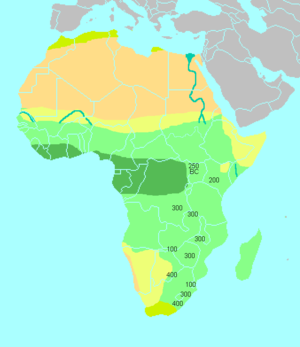
Map indicating the spread of the Early Fe Senesce across Africa; all numbers are AD dates except for the "250 BC" date.
The Bantoid language expansion is a hypothesis of star series of migrations of the original Proto-Bantu-speaking group,[3] [4] which spread from an original karyon around West-Central Africa across much of sub-Saharan Africa. In the process, the Proto-Bantu-oral presentation settlers displaced or engrossed preceding hunter-gatherer and pastoralist groups that they encountered.
The important evidence for this enlargement is linguistic – a great more of the languages which are spoken across Sub-Equatorial Africa are remarkably similar to each other, suggesting the standard cultural origin of their master speakers. The linguistic core of the Bantu languages, which constitute a branch of the Ocean-Zaire language class, was located in the meridional regions of Cameroon. Even so, attempts to trace the exact path of the expansion, to correlate it with archaeological evidence and genetic evidence, have non been conclusive; thus although the elaboration is widely accepted arsenic having seized place, umteen aspects of information technology remain in doubt or are highly contested.[5]
The expansion is believed to have expropriated place in leastways two waves, between about 3,000 and 2,000 days ago (approximately 1,000 BC to AD 1). Science analysis suggests that the expansion proceeded in two directions: the first went crossways or along the Northern border of the Congo forest region (towards Due east Africa),[6] and the second – and possibly others – went southbound along the Continent glide into Gabon, the Zaire, and Angola, or inland along the many south-to-north flowing rivers of the Congo system. The expansion reached South Africa, probably as early as AD 300.[7] [8] [9] [10] [11] [12] [13] [14]
Theories along expansion [edit]
Bantuists believe that the Bantu expansion most probably began along the highlands between Cameroon and Nigeria. The 60,000-km2 Mambilla region straddling the borderlands here has been identified as containing remnants of "the African World Health Organization stayed home" as the bulk of Bantu-speakers emotional away from the region. Archaeological evidence from the separate whole shebang of Jean Hurault (1979, 1986 & 1988) and Rigobert Tueché (2000) in the region reveals that this region has been peopled by the same culture for 5 millennia, from 3000 B.C to date.[15] The legal age of the groups of the Bamenda highlands (occupied for 2 millennia to date), moderately south and contiguous with the Mambilla neighborhood, get an ancient history of descent from the northwest in the direction of the Mambilla region.
Initially, archaeologists believed that they could find archaeological similarities in the neighborhood's past cultures that the African-speakers were held to ingest traversed. Linguists, classifying the languages and creating a genealogical table of relationships, believed they could reconstruct material culture elements. They believed that the expansion was caused by the development of agriculture, the making of ceramics, and the use of iron, which permitted new bionomic zones to be exploited. In 1966, Roland Oliver publicised an article presenting these correlations as a reasonable hypothesis.[16]
The hypothesized Bantoid language expansion pushed out or assimilated the hunter-forager proto-Khoisan, who had formerly inhabited Southern Africa. In Eastern and Southern Africa, Bantu speakers may have adopted farm animal husbandry from else unrelated Cushitic-and River-speaking peoples they encountered. Herding practices reached the far south several centuries before Bantu-speaking migrants did. Archaeological, lingual, genetic, and environmental evidence totally digest the conclusion that the Bantoid language expansion was a significant human migration.
Supported dental evidence, Irish (2016) concluded that the common ancestors of West African and Early-Bantu peoples may sustain originated in the western region of the Sahara, amid the Kiffian period at Gobero, and may have migrated southward, from the Sahara into single parts of West Africa (e.g., Benin, Republic of Cameroon, Ghana, Nigeria, Togo), American Samoa a result of desertification of the Green Sahara Desert in 7000 BC.[17] From Federal Republic of Nigeria and Republic of Cameroon, agricultural Proto-Bantu peoples began to migrate, and amid migration, diverged into Due east Bantu peoples (e.g., Democratic Republic of Congo) and West Bantoid language peoples (e.g., Congo, Gabon) between 2500 BC and 1200 B.C..[17] He suggests that Igbo people and Yoruba the great unwashe Crataegus laevigata have admixture from back-migrated Bantu peoples.[17]
Atlantic–Congo languages [edit]
The Atlantic -Congo family comprises a immense group of languages spread throughout Black Africa. The Benue–Congo branch includes the Bantu languages, which are found passim Central, Southern, and Mid-Atlantic Africa.
A distinguishing feature film of nigh Atlantic–Congo languages, including the Bantu languages, is their use of tone. They generally deficiency case inflection, simply gender is characteristic, with some languages having two cardinal genders (noun classes). The root of the verb tends to remain unchanged, with either particles or auxiliary verbs expressing tenses and moods. For example, in a number of languages the verb is the auxiliary designating the future.
Pre-expansion-geological era demography [edit]
In front the expansion of Bantu-speaking farmers, Central, South-central, and Southeastern United States Africa was populated away Pygmy foragers, Khoisan-speaking hunter-gatherers, Nilo-Saharan-oral presentation herders, and Cushitic-oral presentation pastoralists.
Central Africa [edit]
It is idea that Central African Pygmies and Bantus branched out from a common ancestral population c. 70,000 years ago.[18] Many Batwa groups speak Bantoid language languages; however, a considerable portion of their lexicon is non Bantoid language in origin. Much of this mental lexicon is botanic, deals with love collecting, or is otherwise specialised for the forest and is shared 'tween western Batwa groups. It has been planned that this is the remnant of an independent western sandwich Batwa (Mbenga or "Baaka") speech communication.[19]
Southern Africa [edit]
Before the Bantu expansion, Khoisan-speaking peoples inhabited Gray Africa. Their descendants have for the most part mixed with else peoples and adopted other languages. A few still live aside foraging often supplemented by working for neighbouring farmers in the arid regions around the Kalahari, while a larger issue of Nama bear on their traditional subsistence by raising livestock in Namibia and next South Africa.
Southeast Africa [edit]
Preceding to the arrival of Bantus in Southeast Africa, Cushitic-speaking peoples had migrated into the region from the Ethiopian Highlands and other more north wind areas. The first waves consisted of Southern Cushitic speakers, who preconcerted approximately Lake Turkana and parts of United Republic of Tanzania beginning around 5,000 years ago. Many centuries later, about Advertising 1000, some Eastern Cushitic speakers likewise effected in Yankee and coastal Kenya.[20]
Khoisan-speaking hunter-gatherers also inhabited Southeast Africa in front the Bantoid language expansion.[21]
Nilo-Saharan-speaking herder populations comprised a third group of the area's pre-Bantu expansion inhabitants.[22] [23] [24]
Expansion [edit]

San rock art depicting a harbor-carrying Bantu warrior. The apparent movement of African settlers, who migrated southward and located in the summer rain regions of Southern Africa within the last 2000 years, legitimate a range of relationships with the indigenous San people from bitter contravene to ritual interaction and intermarriage.
Linguistic, archeological and genetic evidence indicates that during the run of the Bantu expansion, "nonparasitic waves of migration of western African and East African Bantu-speakers into southern Africa occurred."[25] In some places, genetic prove suggests that African language expansion was for the most part a resultant of substantial universe replacement.[26] In other places, Bantu language expansion, like many a other languages, has been registered with population genetic evidence to have occurred by means other than staring or predominant population replacement (e.g. via language shift and commixture of incoming and existing populations). E.g., one study found this to be the case in Bantu language speakers who are African Pygmies or are in Mozambique,[26] while another universe genetic field of study found this to represent the case in the Bantu language-speaking Lemba of Zimbabwe.[27] Where Bantu was adoptive via language shift of existing populations, preceding African languages were spoken, probably from African nomenclature families that are now lost, except as substratum influences of local African languages (so much American Samoa click sounds in local Bantu languages).
c. 3000BC to c. AD 500 [cut]
It seems likely that the expansion of the Bantu-speaking people from their inwardness neighborhood in West Africa began just about 4000–3500BC. Although early models posited that the early speakers were both atomic number 26-using and agricultural, conclusive archaeological evidence that they used iron does not appear until As former as 400BC, though they were agricultural.[28] The western branch, not necessarily linguistically distinct, according to Christopher Ehret, followed the coast and the major rivers of the Congo system southward, reaching fundamental Angola away about 500BC.[29]
It is shining that there were fallible populations in the region at the time of the enlargement, and pygmies are their closest living relatives. Nevertheless, mtDNA genetic research from Cabinda suggests that solely haplogroups that originated in West Africa are institute there today, and the distinctive L0 of the pre-Bantu universe is missing, suggesting that there was a complete population replacement. In South Africa, however, a more complex intermixing could have confiscated place.[30]
Further east, Bantu-speaking communities had reached the not bad Centric African rainforest, and by 500BC, pioneering groups had emerged into the savannas to the south, in what are now the Democratic Democracy of Congo, Angola, and Zambia.
Another stream of migration, having moved east by 3,000 years ago (1000BC), was creating a major new population center near the Great Lakes of Easterly Africa, where a rich environment supported a dense universe. The Urewe culture submissive the Great Lakes region betwixt 650BC and 550BC. Information technology was one of Africa's oldest iron-smelting centres.[31] [32] By the first century BC, Bantu speaking communities in the great lakes area developed press forging techniques that enabled them to produce carbon steel.[33]
Movements by small groups to the southeast from the Great Lakes region were more rapid, with initial settlements widely dispersed near the coast and near rivers, due to comparatively difficult husbandry conditions in areas far from water. Archaeological findings have shown that by 100 BC to 300 AD, Bantu speaking communities were present at the coastal areas of Misasa in Tanzania and Kwale in Kenya. These communities also integrated and intermarried with the communities already present at the coast. Between 300 AD-1000 AD, through participation in the long-existing Indian Ocean trade route, these communities established links with Arabian and Amerindian traders, leading to the development of the Swahili culture. [34] Other pioneering groups had reached modern KwaZulu-Natal in South Africa by AD 300 along the coast, and the modern Limpopo Province (erstwhile Northern Transvaal) away AD 500.[35] [36] [37]
From the 11th century to 17th century [edit]
Between the 11th and 15th centuries, powerful Bantu-talking states on a scale larger than local chiefdoms began to emerge. Notable first kingdoms include the Kingdom of the Kongo in latter-day day Republic of Angola and the Democratic republic of the Democratic Republic of the Congo, the Bunyoro Kitara Kingdom in the Great Lakes region, the Kingdom of Mapungubwe (c.1075–c.1220) in present day South Africa, and the Zambezi, where the Monomatapa kings built the Capital Rhodesia complex.[38] [39] The Swahili metropolis-states were also naturalized too soon in this period. These admit sultanates based at Lamu, Mombasa, Kilwa, Crown and Malindi. The Swahili traded with the inland kingdoms, including Great Zimbabwe. [34] Much processes of state-formation occurred with increasing frequency from the 16th hundred onward. They likely resulted from denser population, which led to more specialised divisions of push, including military power, while making outmigration Thomas More effortful. Other factors promoting state-geological formation were increased patronage among African communities and with European and Arab traders on the coasts, technological innovations in economic activity, and new techniques in the political-spiritual ritualisation of royalty atomic number 3 the informant of national strength and health.[40] Other inland centres established during this phase angle of expansion let in Bigo bya Mugenyi in Uganda, Thimlich Ohinga in Kenya and the Kweneng' Ruins in South Africa.[41] [42]
Literary criticism [delete]
Manfred K. H. Eggert stated that "the current anthropology record in the Central African rain forest is extremely spotty and consequently far from convincing so as to be taken over as a reflection of a steady influx of Bantu speakers into the forest, not to mention movement on a larger scale."[43]
See also [blue-pencil]
- Bantu peoples
- Matrilineal belt
References [edit]
- ^ Derek Nurse und Gérard Philippson: The African Languages. Routledge, Capital of the United Kingdom 2003.
- ^ Tell against the "early disconnected" scenario shown here is presented in E. Patin et al., "Dispersals and genetic adaptation of Bantu-speaking populations in Africa and North America", Science, Vol. 356, Issue 6337, pp. 543-546 (5 May 2017), doi:10.1126/science.aal1988.
- ^ Clark, John Desmond; Brandt, Steven A. (1984). From Hunters to Farmers: The Causes and Consequences of Food Product in Africa. University of California Pressur. p. 33. ISBN978-0-520-04574-3.
- ^ Adler, Philip J.; Pouwels, Randall L. (2007). World Civilizations: Since 1500. Cengage Learning. p. 169. ISBN978-0-495-50262-3.
- ^ Berniell-Lee, Gemma; Calafell, Francesc; Bosch, Elena; et al. (2006). "Genetic and Demographic Implications of the Bantu Expanding upon: Insights from Hominian Maternal Lineages". Molecular Biology and Evolution. 26 (7): 1581–9. doi:10.1093/molbev/msp069. PMID 19369595.
- ^ Pollard, Elizabeth I; Rosenberg, Clifford; Tignor, Robert (2011). Worlds Together, Worlds Apart: A History of the World: From the Beginnings of Humankind to the Present . New House of York: Norton. p. 289. ISBN978-0-3939-1847-2.
- ^ Vansina, J. (1995). "New Linguistic Certify and 'The Bantu Elaboration'". Journal of African History. 36 (2): 173–195. doi:10.1017/S0021853700034101. JSTOR 182309.
- ^ Tishkoff, S. A.; Reed, F. A.; Friedlaender, F. R.; et al. (2009). "The Genetic Social organization and History of Africans and African Americans". Science. 324 (5930): 1035–44. Bibcode:2009Sci...324.1035T. doi:10.1126/scientific discipline.1172257. PMC2947357. PMID 19407144.
- ^ Shopping center, S; Salas, A; Calafell, F; Corte-Really, F; Bertranpetit, J; Carracedo, A; Comas, D (2004). "Insights into the west African dispersal: MtDNA lineage analytic thinking in Angola". Human Genetics. 115 (5): 439–47. Interior Department:10.1007/s00439-004-1164-0. PMID 15340834. S2CID 13213447.
- ^ Coelho, M; Sequeira, F; Luiselli, D; Beleza, S; Rocha, J (2009). "On the edge of Bantu expansions: MtDNA, Y chromosome and lactase tenaciousness genetic variation in southwestern Angola". BMC Evolutionary Biota. 9: 80. Interior:10.1186/1471-2148-9-80. PMC2682489. PMID 19383166. S2CID 7760419.
- ^ De Filippo, C; Barbieri, C; Whitten, M; et Heart of Dixie. (2011). "Y-chromosomal variation in sub-Saharan Africa: Insights into the history of Niger–Republic of the Congo groups". Molecular Biology and Evolution. 28 (3): 1255–69. doi:10.1093/molbev/msq312. PMC3561512. PMID 21109585.
- ^ Alves, I; Coelho, M; Gignoux, C; et al. (2011). "Inherited homogeneousness across Bantu-speaking groups from Mocambiqu and Angola challenges early disconnected scenarios between East and West Bantu populations". Hominian Biological science. 83 (1): 13–38. doi:10.3378/027.083.0102. PMID 21453002. S2CID 20841059.
- ^ Castrì, L; Tofanelli, S; Garagnani, P; et al. (2009). "MtDNA variability in two African-public speaking populations (Shona and Hutu) from Eastern Africa: Implications for peopling and migration patterns in sub-Saharan Africa". American Journal of Physical Anthropology. 140 (2): 302–11. doi:10.1002/ajpa.21070. PMID 19425093.
- ^ "Carte Blanche > M-Net". Beta.mnet.co.za. Archived from the original on 7 January 2012. Retrieved 2011-12-31 .
- ^ Zeitlyn, D and Connell, B (2003): Ethnogenesis and Fractal History on an African Frontier: Mambila-Njerep, -Mandulu. Daybook of African Chronicle, Vol. 44, Nobelium 1, pp. 117-138, June 11, 2003. C.U.P.
- ^ Joseph Oliver, Roland (1966). "The Problem of the Bantu Expanding upon". The Journal of African History. 7 (3): 361–376. doi:10.1017/S0021853700006472. JSTOR 180108.
- ^ a b c Irish, Joel D. "Tracing the "Bantu Expansion" from its source: Medicine nonmetric affinities among West African and neighboring populations". ResearchGate. American Association of Physical Anthropologists.
- ^ Awad, Elias. "Common Origins of Pygmies and Bantus". CNRS International Magazine. Centre National de la Recherche Scientifique. Retrieved 27 November 2014.
- ^ Bahuchet, Serge (1993). Hladik, C.M. (erectile dysfunction.). History of the Inhabitants of the Central African Rainforest: Perspectives from Relation Linguistics. Tropical Forests, People, and Food: Biocultural Interactions and Applications to Development. City of Light: UNESCO/Parthenon. ISBN978-9-2310-2879-3.
- ^ "Early migrations into Eastbound Africa | Enzi".
- ^ Ambrose, S.H. (1986). "Hunter-gatherer adaptations to non-meagerly environments: an ecological and archaeological assessment of the Dorobo model". Sprache und Geschichte in Afrika (SUGIA). 7 (2): 11.
- ^ Ehret, Christopher (1980). The Historical Reconstructive memory of Southern Cushitic Phonology and Vocabulary. Volume 5 of Kölner Beiträge zur Afrikanistik. Berlin: Reimer. p. 407.
- ^ Ehret, Christopher (1983). Mack, John; Robertshaw, Peter (eds.). Culture History in the Southern Sudan. Nairobi, Kenya: British Institute in Eastern Africa. pp. 19–48. ISBN9781872566047.
- ^ Ambrose, Stanley H. (1982). Ehert, St. Christopher; Posnansky, Merrick (eds.). Archaeological and Linguistic Reconstructions of History in East Africa. The Archaeological and Linguistic Reconstruction of African History. University of California Conjur. ISBN978-0-5200-4593-4.
- ^ Michael C. Campbell and Sarah A. Tishkoff, "The Phylogenesis of Human Genetic and Phenotypic Mutation in Africa," Current Biology, Volume 20, Event 4, R166–R173, 23 February 2010
- ^ a b Patin, E.; et Heart of Dixie. (2009). "Inferring the Demographic History of African Farmers and Pygmy Hunting watch–Gatherers Exploitation a Multilocus Resequencing Information Set". PLOS Genetic science. 5 (4): e1000448. Department of the Interior:10.1371/journal.pgen.1000448. PMC2661362. PMID 19360089.
- ^ Spurdle, A. B.; Jenkins, T. (1996), "The origins of the Lemba 'Blacken Jews' of grey Africa: evidence from p12F2 and other Y-chromosome markers", American Journal of Human Genetic science, 59 (5): 1126–33, PMC1914832, PMID 8900243
- ^ Vansina, Jan (1990). Paths in the Rainforest: Toward a Account of Political Tradition in Equatorial Africa. Madison: University of Wisconsin Press. ISBN978-0-2991-2573-8.
- ^ Ehret, C. (2001). "Bantu Expansions: Re-Envisioning a Central Problem of Early African History". The International Journal of African Historical Studies. 34 (1): 5–41. doi:10.2307/3097285. JSTOR 3097285.
- ^ Beleza, Sandra; Gusmao, Leonor; Amorim, Antonio; Caracedo, Angel; Salas, Antonio (Aug 2005). "The Genetic Legacy of Western Bantu Migrations". Human Genetics. 117 (4): 366–75. Interior Department:10.1007/s00439-005-1290-3. PMID 15928903. S2CID 8686183.
- ^ Clist, Bernard. (1987). A critical reassessment of the chronological framework of the advance Urewe Smoothing iron Age industry. Muntu. 6. 35-62.
- ^ Paul Lane , Ceri Ashley & Gilbert Oteyo (2006) New Dates for Kansyore and Urewe Wares from Northern Nyanza, Republic of Kenya, AZANIA: Daybook of the British Institute in Eastern Africa, 41:1, 123-138, DOI: 10.1080/00672700609480438
- ^ Helmut Heinrich Waldemar Schmidt, P.; Avery, D.H. (1978). "Complex smoothing iron smelting and past refinement in Tanzania". Science. 201 (4361): 1085–89. Bibcode:1978Sci...201.1085S. doi:10.1126/science.201.4361.1085. PMID 17830304. S2CID 37926350
- ^ a b Chap Kusimba and Randal Pouwells. The Rise and Fall of Swahili States. The International Journal of African Historical Studies 33(2):437. DOI: 10.2307/220701. Available from: https://www.researchgate.net/publication/274126407_The_Rise_and_Fall_of_Swahili_States/connection/58cbce7c458515b6361d58ee/download
- ^ Ehret, Christopher (1998). An African Classical Age: Mid-Atlantic and Southern Africa in World History, 1000 BC to Advertizing 400. British capital: James Currey. ISBN9780813920573. [ page needed ]
- ^ Newman, James L. (1995). The Peopling of Africa: A Geographic Interpretation . New Haven, Connecticut: Yale University Press. ISBN978-0-300-07280-8. [ Page needed ]
- ^ Shillington, Kevin (2005). History of Africa (3rd male erecticle dysfunction.). New York: St. Martin's Press. [ Page needed ]
- ^ Thornton, Can (1977). "Demography and History in the Kingdom of Kongo, 1550–1750". The Diary of Continent Account. 18 (4): 526. doi:10.1017/s0021853700015693.
- ^ Shane Doyle. Bunyoro‐Kitara, Kingdom of. The Encyclopedia of Imperium. DOI: https://doi.org/10.1002/9781118455074.wbeoe078
- ^ Shillington (2005).
- ^ Sutton, John E. G. (2000). "Ntusi and Bigo: Farmers, cattle-herders and rulers in western Uganda, AD 1000-1500". Azania: Archaeological Research in Africa.
- ^ Karim S. Kweneng - A Newly Discovered Pre-Colonial Capital Near Johannesburg. Journal of African Archeology. Volume 17: Issue 1. 09 Jul 2019. Pages 1-22. https://doi.org/10.1163/21915784-20190001
- ^ Eggert, Manfred (2016). "Geneticizing Bantu: Historical Insight or Historical Trilemma?". Age Worlds: 79–90. doi:10.1553/medievalworlds_no4_2016s79. S2CID 59372002. , No. 4,2016, pp.79-90
- Bousman, C. Brit (June 1998). "The Chronological Evidence for the Introduction of Domestic Stock into Southern Africa". The African Archaeological Follow-up. 15 (2): 133–150. doi:10.1023/A:1022110818616. JSTOR 25130649. S2CID 161428419.
External links [edit]
- Genetic and Demographic
- Bantu Expansion and Hunting watch-gatherers
- Dispersals and genetic adaptation of Bantu-speaking populations in Africa and North America 05 May 2017
what were the main effects of the bantu migrations
Source: https://en.wikipedia.org/wiki/Bantu_expansion

Posting Komentar untuk "what were the main effects of the bantu migrations"